

Manufacturing and metalworking require precision and complexity in the parts produced in this huge and complicated world-not as an ambition but as a need. Among the various technologies that abound, EDM, otherwise known as Electrical Discharge Machining, has appeared as a ray of hope, especially for materials that pose problems to conventional machining. Among the many EDM types available, Sinker EDM and Wire EDM are two of the most improvised techniques, each having advantages and their respective areas of application.
For this article, Sinker EDM has been differentiated from Wire EDM in a way that you will know in which direction to go in choosing either.
What Is EDM Machining?
EDM is a non-traditional manufacturing process in which material removal from an electrically conductive material takes place through the action of electric sparks. The method is well adapted for hardened steel cutting and complex shape generation, which is difficult or impossible to obtain by traditional machining. EDM causes erosion of a material submerged in a dielectric fluid between an electrode and a workpiece through the action of sparks.
Having so many uses is what makes EDM highly important in industries such as aerospace, mold making, and medical devices. Its uniqueness in creating complex designs and performing deep hole machining separates it from the other methods. Its efficient processing of hardened materials guarantees high accuracy with the finest surface finishes, therefore making EDM highly essential technology in modern manufacturing.
How Does The EDM Machining Process Work?
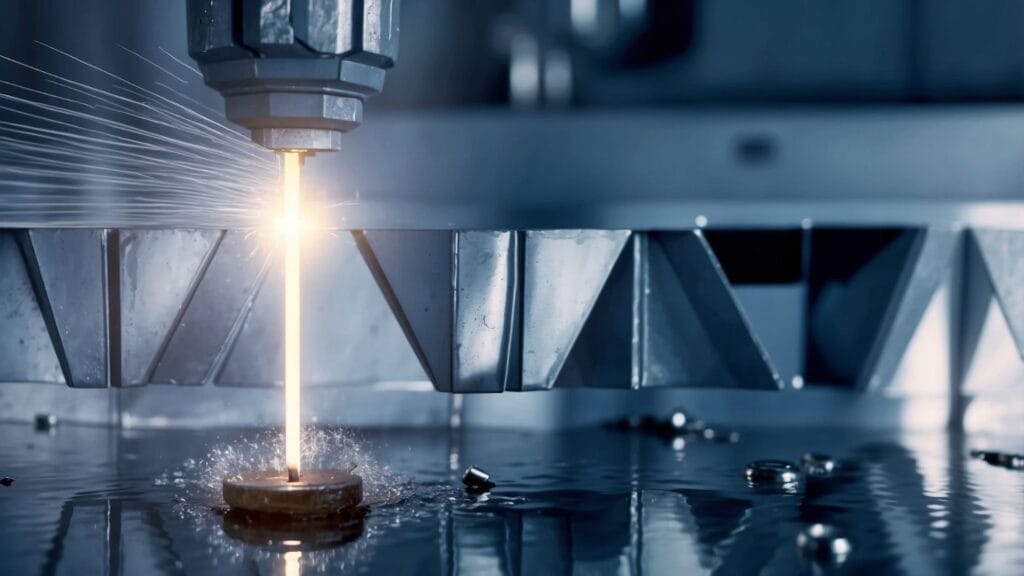
Electrical discharges between an electrode and workpiece should be coordinated to get different shapes and profiles in an EDM machining process. It works on the principle of plasma generation. If the voltage between the electrode and workpiece increases beyond the breakdown voltage of the dielectric fluid, it ionizes and creates a small gap from 0.01 to 0.50 millimeters, allowing the generation of high-temperature sparks.

These sparks heat the dielectric fluid, which, in turn, erodes part of the workpiece. When the spark discharge is over, the immediate neighboring dielectric fluid, by this time cooled, allows the eroded metal to solidify. The dielectric fluid further helps in flushing the eroded material away, hence leaving a clean machine. This highly controlled process enables very accurate cuts and complex shapes to be obtained, making EDM a core technology in today’s manufacturing.
What Is Sinker EDM Machining?
Sinker EDM is more commonly known as Ram EDM. Electrical discharge machining is a manufacturing process in which a desired cavity-shaped workpiece is produced by the method. The electrode involved in the Sinker EDM process is a match to the negative profile of the part to be made. It can, therefore, be used to form complicated geometries with great accuracy.
In the process, the electrode is brought into close proximity to the workpiece while immersed in dielectric fluid. Due to this arrangement, electrical discharges are created, causing erosion of the material and forming the cavities accordingly. The term “sinker” means that the electrode is actually “sinking” into the conductive material, shaping it precisely to the required mold.
How Does The Sinker EDM Machining Work?
Sinker EDM is a very accurate process of metal removal, which is essentially based on a conductive workpiece, dielectric fluid, electrode, servo motor controller, and voltage/current generator. When turned on, there is a high-voltage charge that creates a spark gap voltage between the workpiece and electrode, creating sparks as hot as 12,000°C. This mechanism effectively removes minute particles of metal, creating a negative shape of the electrode.
During the process, the dielectric fluid acts as a good insulator and inhibits electrical arcing while also clearing the chips to provide the desired surface finish. Although the result of sinker EDM can be like that of a mirror, in most applications this process may require further surface treatments such as painting, drilling, and deburring. This process, under good control and adjustments, allows perfect machining efficiency and versatility in a wide range of industrial applications.
Advantages Of Sinker EDM Machining
What makes Sinker EDM a preferred choice for certain applications?
Sinker EDM machining is highly capable of producing intricate shapes and detailed features that are difficult to achieve with traditional machining processes. This technology enables manufacturers to create complex geometries that enhance product design and functionality, making it an invaluable tool for industries that require precision.
This process allows for the achievement of very tight tolerances, which is crucial in sectors such as aerospace and medical device manufacturing. The ability to maintain strict tolerances ensures that components fit perfectly, enhancing performance and reliability, thereby minimizing the risk of failure in critical applications.
Sinker EDM is particularly suited for machining hardened materials, such as hardened steel, which would quickly wear out traditional cutting tools. This advantage allows manufacturers to work with tough materials without compromising on tool life or quality, making it an ideal choice for applications that demand durability and precision.
Disadvantages Of Sinker EDM Machining
No manufacturing process is perfect.Here are some drawbacks to consider.
Sinker EDM machining can be less efficient than some traditional machining methods, especially for high-volume production runs. The process typically involves slower material removal rates, which can lead to longer cycle times, making it less suitable for applications requiring rapid output.
The wear of the electrode during the machining process can significantly impact accuracy over time. As the electrode degrades, it may fail to maintain the same precision in shaping the workpiece, potentially resulting in deviations from desired specifications, particularly in intricate designs that demand high fidelity.
The initial investment for Sinker EDM equipment can be significantly higher compared to traditional machining setups. This upfront cost may deter smaller manufacturers from adopting the technology, despite its advantages in precision and capability for producing complex shapes, limiting its accessibility to a broader market.
What Is Wire EDM Machining?
Wire EDM is a special form of electrical discharge machining in which a continuously moving fine wire is used as an electrode. It is very effective for cutting out geometrical shapes and intricate details from thin materials and hence is one of the indispensable techniques in various industries.
During Wire EDM, the workpiece is fed along with a moving wire, which then carries the electrical discharge. This wire cuts the material, hence giving extremely accurate and clean cuts. This results in very high precision with little heat distortion, thus preserving the integrity of the workpiece, enabling the realization of intricate designs without compromising on the quality of the material.
When contemplating EDM Wire for your forthcoming project, a variety of positive attributes is gained. It realizes very good accuracy, making it suitable for applications that need fine details and exact cuts. In addition, the material which can be treated by the method includes hardened steels and other electrically conductive substances. Small thermal impact reduces distortion in the workpiece, which protects material integrity. However, considering a couple of disadvantages, for example, it is limited to material thickness because Wire EDM is generally suited for dealing with thinner materials. Furthermore, consumable wire can become really expensive to replace, affecting the overall cost of the process and project budgets.
Difference Between Sinker EDM And Wire EDM
As you consider your options, what are the key distinctions between these two techniques?
| Attribute | Sinker EDM | Wire EDM |
| Electrode Type | Utilizes a shaped solid electrode made from materials like graphite or copper, allowing for the creation of complex geometries. | Employs a thin wire made of brass or copper that continuously feeds through the machining area, facilitating precise cutting. |
| Geometry | Capable of producing 3D cavities and intricate shapes, making it ideal for applications requiring complex profiles. | Primarily suited for creating 2D shapes and contours, with limited capability for some 3D profiling, typically for simpler geometries. |
| Material Removal | Generally involves slower material removal rates, which allows for the detailed machining of intricate 3D shapes. | Features faster material removal, enabling precise 2D cuts through various conductive materials efficiently. |
| Material Types | Effective for a range of conductive materials, including hardened steel and carbide, making it suitable for tough applications. | Also works with various conductive materials, including steel, titanium, and carbide, offering versatility in material choice. |
How To Choose Between Sinker EDM And Wire EDM?
Sinker EDM versus Wire EDM is one of those critical decisions that you have to make when it pertains to the manufacturing process. Both these methods have their merits, which indicate the feasibility of their application under different conditions. Here are some of the factors to consider when you are choosing between Sinker EDM and Wire EDM: Material Type and Thickness: Take Wire EDM for thinner materials since it’s effective. Sinker EDM will serve you best in the case of thicker materials where depth and complexity are required.
Geometry Of The Part: Wire EDM is ideal for parts with tight tolerances and complicated shapes. Sinker EDM is ideal for deep cavities or molds requiring intricate 3D shapes.
Surface Finish: Looking into surface finish, Wire EDM gives a much finer finish with less post-processing required. Sinker EDM allows for a much coarser finish and may require further treatment.
Production Volume: Sinker EDM is slower and, therefore, suitable for low production volume. On the other hand, Wire EDM is suitable for higher production runs.
Cost Issue: Wire EDM, in general, is less costly. On the other hand, Sinker EDM may have a higher investment cost due to advantages in quality and complexity.
Conclusion
Your choice between Sinker EDM and Wire EDM should be for the accomplishment of your particular needs in manufacturing. Considering all the aforementioned factors carefully will let you make a more informed decision that could favorably enhance your production efficiency and meet the requirements of your project effectively.
Final Thoughts
As a professional with 15 years of CNC machining service experience, I find that Sinker EDM and Wire EDM each have unique advantages. Sinker EDM is ideal for complex shapes and deep cavities; for instance, we once processed injection molds for a medical device manufacturer, ensuring high precision and excellent surface finish. On the other hand, Wire EDM excels in handling thin materials and intricate profiles. We provided this service for an automotive parts supplier, enhancing cutting speed while maintaining tight tolerances. Choosing the right machining method is crucial for improving production efficiency. Ultirapid has extensive experience in both methods, and we welcome you to contact us to meet your CNC machining needs.
Faqs
How Deep Can A Wire EDM Cut?
Wire EDM can typically cut to a depth of around 300 mm (approximately 12 inches), although this can vary based on the machine’s specifications and the type of wire used. Some advanced machines may achieve deeper cuts, but practical limitations often depend on factors like the workpiece material, thickness, and desired tolerances.
Can Wire EDM Make Holes?
Yes, Wire EDM can be used to create holes, including small and precise holes. The process is particularly effective for drilling through hard materials or creating intricate hole shapes that may be challenging to achieve with traditional drilling methods. Wire EDM allows for very tight tolerances and can produce holes with smooth finishes, making it suitable for applications in various industries, such as aerospace and medical device manufacturing.
What Is The Main Similarity Between Sinker EDM And Wire EDM?
The main similarity between Sinker EDM and Wire EDM is that both are forms of Electrical Discharge Machining (EDM). They utilize the principle of electrical discharges to remove material from conductive workpieces. Both processes are capable of achieving high precision and intricate shapes, making them suitable for applications that require tight tolerances and complex geometries. Additionally, both methods are effective for machining hard materials that are difficult to cut using traditional methods.


