
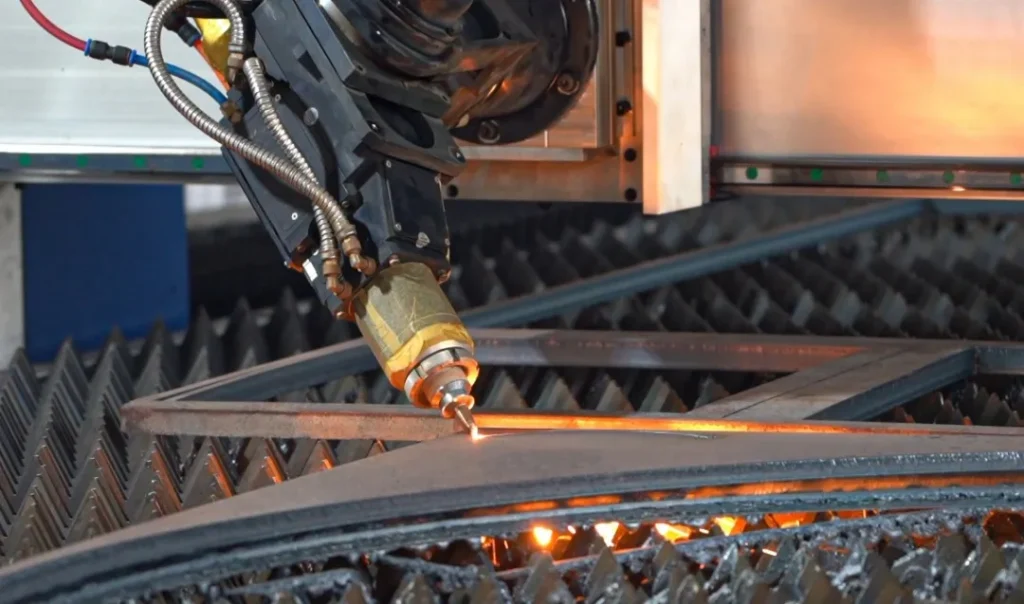
Although a small part, the nozzle is in charge of executing many industrial systems’ operation processes efficiently. Its quality in machining directly influences the precision of fluid control and, in general, equipment performance. Nozzles play their part, from meeting high precision for space down to optimizing everyday industrial processes. We are going to look at the types of nozzle machining, functions, and their diverse uses across different industries.
What Is Nozzles?
Nozzle, Spray Head, or Jet Nozzle The nozzle is an important part in many types of equipment when there is a requirement for spraying, misting, oiling, sandblasting, and coating.
Nozzles need regular maintenance, such as inspection, cleaning, or replacement, to maintain the quality of the end product and to keep the process economically viable. Maintenance or replacement can be scheduled by customers based on application, liquid applied, and material of the nozzle.
The clogged nozzle can only be cleaned by a soft brush or toothpick, and cleaning must be done with extreme caution. It also can distort the orifice by cleaning the opening of the nozzle even by using a wood toothpick.Accessories used with nozzles are pipe thread fittings, solenoid valves, liquid filters, and pressure gauge connectors.
What Are The Functions Of A Nozzle?
Nozzles are used to carry out a number of functions in numerous factories and pieces of equipment worldwide. When studying nozzle performance, it is valuable to grasp the five key activities nozzles generally need to carry out:
- Meeting Liquid Flow Requirements: Under a certain pressure, the nozzle should provide a specific flow rate, usually measured in liters per minute (L/min).
- Creating Spray Patterns: The common spray patterns include full cone, hollow cone, fan shape, and jet shape.
- Atomizing Particles: The size of the atomized particles depends on the liquid that is being sprayed, type of nozzle, flow rate, and pressure. Sizes typically range between 20 to 10,000 micrometers (µm).
- Generating Impact Force: It is the amount of force created or caused by the spray on the surface it banks on, usually expressed in kg forces per square centimeter, or MPa. It depends on various factors, including flow rate, spray pattern, nozzle type, spray distance, and pressure.
- Ensuring Spray Velocity: Liquid pressure is converted into high-velocity jets, taking on a particular velocity, usually expressed in meters per second (m/s). Liquid velocity will be specially desired for high-pressure cleaning, steel descaling, and cooling of flue gases.
Classification Of Nozzles
Nozzles can be classified into open nozzles, shut-off nozzles, hot runner nozzles, and multi-channel nozzles.
Open Nozzle
The open nozzle is of simple construction, easy to fabricate, and possesses a low friction loss pressure drop but is prone to drooling.
Axial hole type: the diameter d is 2–3mm, length L is 10–15 times of diameter, suitable for thin wall product made by material with medium and low viscosity, and thermal stability, for example, PE, ABS, PS.
Long tapered type With the D of 3–5 times that of d, this shape is suited to thick-walled products made from materials with high viscosity and poor thermal stability such as PMMA and PVC.
Self-locking Nozzle
There are several structural forms of self-locking nozzles. During pre-plasticization, spring force presses the ejector pin through retaining ring and guiding rod to make the cone surface of ejector pin close the nozzle hole. Under high pressure during injection, the melt pressure exerts an axial force on the cone surface of the ejector pin. Compression of the spring takes place through the guide rod-retaining ring, allowing the high-pressure melt to flow from the nozzle hole into the mold runner.
Its main drawbacks are that the nozzle has large pressure loss during injection, is structurally complicated, and hard to clean; has poor dripping resistance, and often leaks from the mating surface. Working principle: The moving force of an injection seat acts to open or shut the nozzle. Pre-plasticization-the nozzle moves away from the main runner of the mold, with the forward movement of a nozzle core caused by melt under back pressure, which closes the feed runner. During Injection: forward movement of an injection seat pushes the core of a nozzle backward, opening the runner and allowing melt to inject into the mold cavity.
Hydraulic Nozzle
The nozzle ejector pin is controlled by external force, sealing during pre-plasticization and opening during injection.
This type of nozzle ejector pin sealing action is integrated into the injection molding machine’s control program and requires the setup of a nozzle control cylinder. The seal between the nozzle ejector pin and the guide bushing is crucial. Under high back pressure, there is a potential for melt leakage, so it must be coordinated with anti-drool procedures.
Hot Runner Nozzle
Hot runner nozzles have very narrow flow channels, which are in contact with the mold’s main runner, and hence are susceptible to heat loss. After holding pressure and cooling, leftover material inside the nozzle will freeze and block the flow, while the next injection cycle may affect the quality of the product. Therefore, hot runner nozzles are commonly used in injection molding and coordinate with hot runner molds so as to form a complete hot runner injection system. In this way, it ensures product quality, shortens the cycle of injection molding, saves raw materials, and reduces energy consumption. According to the structure, the hot runner nozzles have two kinds of main types: thermal insulation type and internal heating type.
Thermal Insulation Type Nozzle
Figure 2-28 Thermal insulation type nozzle structure The characteristic of this design is to form a space of material between runner sleeve 1, pressure ring 3 and nozzle 4. After the first injection, this space is occupied by molten material. A large amount of heat capacity acts, and can maintain the temperature of the flow channel of the nozzle for anticlogging, so as to achieve continuous injection.
Internal Heating Type Nozzle
The structure of the internal heating type nozzle is shown in Figure 2-29. The feature of this design is the installation of a diverter (5) between the nozzle (3) and the flow channel seat (6). The nozzle is equipped with a heater (4) and a probe (2). The nozzle and the mold form a material space to maintain thermal insulation. In the process of injection, the heater is on, the instant heat of the probe, and it starts melting the cold material in the nozzle. After injection and pressure holding, turn off the power, and the nozzle will naturally seal.
Application Of Nozzle
Nozzles come in all shapes and sizes-from stainless steel, plastic, and silicon carbide to PTFE, PP (engineering plastics), aluminum alloy, and tungsten carbide. In general, applications may be categorized into the following four types of spray applications:
Cleaning, Washing, Rinsing: This involves high-pressure descaling such as in the processing of hot rolling, medium-pressure as well as high-pressure cleaning of products, automobiles, and equipment. It also encompasses low-pressure washing and rinsing.
Coating: Applications involving spray coating include the spraying of rust inhibitors, plastic coatings, mold release agents, lubricants, protective films, wetting agents, and curing agents.
Cooling: The spraying applications cool the solid target in these applications, such as continuous casting billet cooling, roller cooling, cooling of assembling parts, processing equipment, and tank cooling, together with cooling by circulating water.
Special Applications: These include dust control and air and flue gas spraying, spray drying, granulation, and spray humidification.
Advantages Of Nozzle
It is time-saving, cost-saving, and energy-saving that are the eternal pursuits of all industrial enterprises. Relatively, nozzles are small in size in the steel industry compared with other equipment and components. Their influence on process operations and maintenance is often indirect, so whether the nozzles used are time-saving, cost-saving, and energy-saving is often overlooked or not properly addressed.
Time-saving can be reflected in three aspects:
Easy replacement.Long service life, fewer replacements. Timely replacement according to standard: For example, the continuous casting nozzles in some plants could not be replaced according to the standard in due time. Although it is true to say that time was saved, this was because of the performance of the nozzles degraded severely: Steel leakage and defective products occurred; consequently, time was spent on maintenance and sorting.
This cost saving needs more comprehensive and balanced calculations; the cost savings should be calculated for the steel tons or material so that actual cost saving is realized. Affordable alternatives are not always cost-effective. Over-functionality leads to waste.
Energy-saving is the field that can bring the biggest effect with the help of nozzles: for instance, in cooling and taking away dust from a 20-ton converter, classic water nozzles used 150–200 tons of water per hour, while after nozzle renovation, it is possible to save at least one-third of water. In the case of slab continuous casting machines, early designs of air-water atomizing nozzles used about 80m³/h of compressed air per nozzle, while the minimum used was around 20-30m³/h. With advances in air-water atomization nozzles, nowadays the most advanced types use less than 10 m³/h of compressed air.
Conclusion
Conclusion Nozzles play critical roles in manufacturing industries, particularly in the production of steel. Their types range from an open-type, self-locking, to hydraulic nozzles, all serving specific functions that affect efficiency, quality, and precision in the processes in which they are employed. Nozzles are critical in regulating fluid flow, generating proper spray patterns, and maintaining ideal pressure and temperature conditions, thus finding a niche in applications related to cooling, cleaning, coating, and dust control.
In addition, new developments in nozzle design allow significant time-saving, cost efficiency, and energy conservation, adding value for industrial applications. Therefore, proper nozzle selection, maintenance, and timely replacement have great potential to bring substantial improvements in operational efficiency, product quality, and overall production costs, which reinforces their importance in modern industrial practice.
Final Thoughts
As a professional with 15 years of CNC machining service experience, I understand the critical role that nozzles play in various industries. The type, function, and application of nozzles directly affect product precision and production efficiency. For instance, in steel production, selecting the right nozzle can significantly reduce water and energy consumption while improving cooling effectiveness. By optimizing nozzle design and machining, we successfully provided custom nozzles for a client, reducing their cooling water usage by 30% and enhancing production line stability. Ultirapid, as an expert in CNC precision machining, has extensive experience in nozzle fabrication and can offer tailored solutions to ensure efficient, energy-saving, and stable production environments.


