
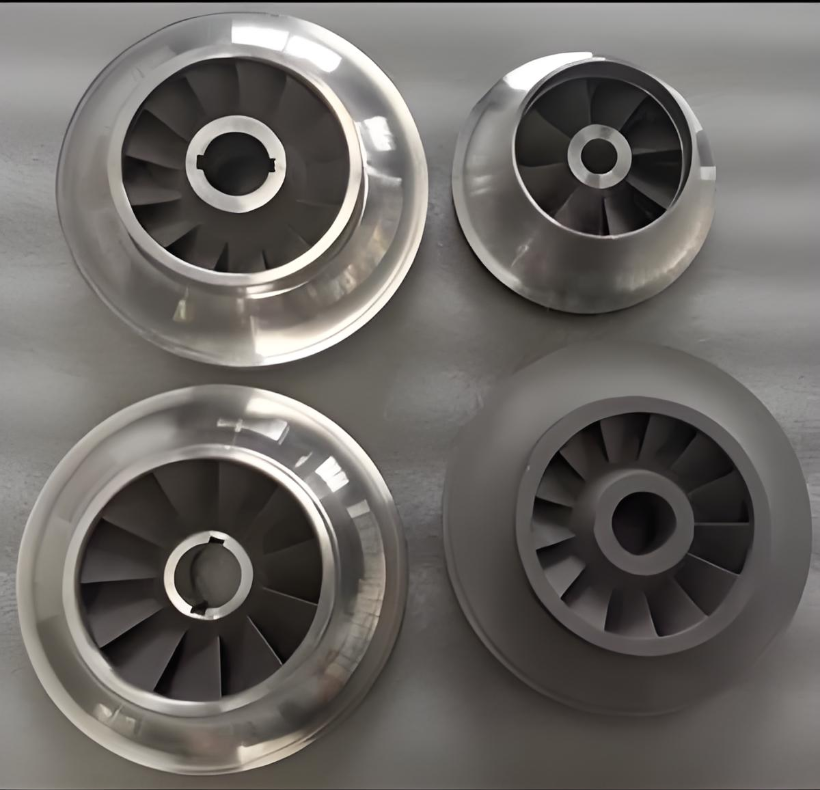
In high-precision environments such as semiconductor fabrication, vacuum compressors must operate with minimal vibration and noise. These issues, primarily stemming from mechanical imbalances, airflow pulsations, and electromagnetic interference, can severely impair system performance and durability. As semiconductor manufacturing demands increase, the need to enhance stability, reduce operational noise, and ensure long-term reliability becomes more critical than ever. This article explores how impeller machining methods directly affect vibration and noise levels in vacuum compressors, offering insights into design optimization, material selection, manufacturing precision, and active/passive control technologies. A deeper understanding of the interplay between impeller structure, machining techniques, and acoustic dynamics opens pathways to quieter and more efficient compressor systems.
Causes of Vibration and Noise in Compressors
Compressor systems, particularly in high-speed and high-precision applications such as semiconductor manufacturing or HVAC systems, are prone to various sources of vibration and acoustic noise. These disturbances not only affect system performance and durability but can also lead to user discomfort and mechanical failure. Understanding the root causes is essential for implementing targeted suppression strategies. The main sources can be broadly categorized into mechanical, aerodynamic, and electromagnetic factors.
Mechanical Vibration Noise
Mechanical vibrations arise primarily from the rotating components within the compressor. Imbalances in mass distribution on rotors, coupling misalignment, or gear wear can generate oscillatory motion. The friction within bearings and the backlash or engagement of gear teeth contribute significantly to tonal vibration. In screw compressors, gear meshing frequency often resonates with structural components, amplifying the perceived noise.
Moreover, rotor eccentricity—when the rotor centerline deviates from its intended axis—introduces asymmetrical loading on bearings and housings. This not only leads to mechanical wear but also produces persistent low-frequency noise and vibration, especially at higher speeds or under varying loads.
Aerodynamic Pulsation Noise
In centrifugal and screw compressors, the uneven flow of gas through rotating impellers or rotors and static components like the volute or casing creates pressure fluctuations. These pulsations travel through the air and housing, producing a broadband acoustic spectrum. Sudden changes in flow velocity, blade tip vortices, or separation in boundary layers can all contribute to turbulent, irregular airflow—an established source of aerodynamic noise.
Furthermore, mismatches between impeller blade count and volute geometry may create tonal harmonics or beat frequencies, further complicating the noise profile and making passive suppression more difficult.
Electromagnetic Noise
Electromagnetic noise originates from the interaction between the motor’s rotating magnetic field and the stator core. In modern compressors, especially those using high-efficiency permanent magnet synchronous motors (PMSMs), torque ripple and magnetic flux variations can generate high-frequency vibrations. These manifest as audible whining or buzzing sounds that vary with motor load and speed.
Inadequate motor control strategies, such as improper pulse-width modulation (PWM) schemes, may exacerbate these effects. Conversely, optimized stator design and advanced control algorithms—like vector control or space vector modulation—can substantially minimize electromagnetic noise generation.
Impact of Impeller Design on Noise and Vibration
The aerodynamic and structural characteristics of impeller blades play a critical role in determining the acoustic and vibrational behavior of compressors. A well-optimized impeller not only improves overall efficiency but also contributes significantly to noise suppression and vibration minimization. By adjusting key design parameters—such as blade angles, thickness, clearance, and stagger—engineers can reduce unsteady flow phenomena and mechanical imbalance, which are the primary sources of compressor noise.
Blade Profile Optimization
Careful adjustment of the blade inlet and outlet angles can guide airflow more smoothly through the impeller passage. An optimized trailing edge inclination reduces flow separation and suppresses vortex shedding—two main contributors to tonal and broadband aerodynamic noise. In particular, forward-swept blade designs have been proven effective in delaying boundary layer separation and stabilizing the wake flow at the impeller exit. This results in reduced pressure pulsation and lower noise levels, especially under high-speed operating conditions.
Moreover, proper blade profiling contributes to more uniform velocity distributions across the flow channels, minimizing secondary flow structures that induce unsteady forces on the blades. This, in turn, reduces blade vibration amplitude and acoustic emissions linked to flow-induced excitation.
Blade Thickness and Clearance
The thickness of the blade impacts the local flow resistance and wake generation. Thicker blades tend to generate stronger vortices and contribute to higher aerodynamic noise, particularly when operating near choke or stall points. Additionally, increased blade tip clearance allows leakage flow, creating pressure instabilities and eddies that intensify tonal noise.
To counteract this, impeller designs are increasingly favoring thinner blade sections where structurally feasible and minimizing clearance through advanced manufacturing and tighter tolerances. These modifications not only reduce turbulence intensity but also improve overall flow coherence, thereby lowering both noise and mechanical vibration levels.
Stagger Angle and Blade Height Line Control
The stagger angle—the orientation of the blade relative to the flow direction—greatly influences blade loading and flow turning efficiency. Varying the stagger angle at different heights allows for load redistribution along the blade span, effectively reducing flow non-uniformity and unbalanced aerodynamic forces. This technique is particularly useful for mitigating vortex formation near the blade root or tip.
Furthermore, optimizing the blade height line (the radial projection of the blade centerline) ensures that pressure differentials along the blade span are controlled. This minimizes radial pressure gradients and uneven force distribution, resulting in lower structural excitation and reduced vibration. A smoother pressure recovery also contributes to quieter compressor operation, particularly at part-load conditions.
Influence of Impeller Machining on Acoustic Performance
The acoustic performance of compressors is not only a function of aerodynamic design but also closely linked to how the impeller is machined and finished. Factors such as surface texture, material choice, and heat treatment significantly impact noise generation, vibration levels, and long-term stability. Optimizing machining processes enhances both structural integrity and acoustic quietness by reducing sources of excitation and energy loss. Below are key areas where machining choices influence acoustic outcomes:
Surface Finish and Dimensional Accuracy
Improving surface finish is a fundamental approach to reducing aerodynamic noise. Transitioning from traditional milling to high-precision grinding significantly lowers surface roughness, which minimizes boundary layer disturbances, flow separation, and the formation of secondary vortices. These flow irregularities are known contributors to tonal and broadband noise in compressors.
In addition, better dimensional accuracy ensures tighter tolerances between components, which reduces mechanical looseness and misalignment. This results in smoother operation and decreased friction-induced vibration, further suppressing mechanical noise emissions. High-quality finishes also enhance wear resistance and maintain optimal performance over time.
Material Selection
The choice of material directly affects the vibrational and acoustic behavior of the impeller. High-strength materials like titanium alloys, alloy steels, or advanced composites offer greater stiffness and resistance to dynamic loads. This increased rigidity limits structural deformation under high-speed operation, ensuring consistent blade spacing and preserving aerodynamic integrity.
Moreover, materials with good damping characteristics can absorb vibrational energy rather than transmitting it. This intrinsic property contributes to noise attenuation, especially under varying thermal and mechanical conditions, thus supporting more stable acoustic performance over the machine’s lifespan.
Heat Treatment Processes
Applying controlled heat treatment processes, such as quenching, tempering, or aging, enhances the mechanical properties of the impeller material. These treatments increase hardness and wear resistance while refining the grain structure to improve fatigue strength.
From an acoustic standpoint, a refined microstructure helps dissipate vibrational energy and improves the component’s ability to damp mechanical oscillations. This means that impellers treated through optimized thermal processes are better equipped to resist resonance, maintain dimensional stability, and suppress sound generated from structural vibrations.
Vibration and Noise Control Technologies
Controlling vibration and noise in high-speed rotating equipment like compressors is critical for enhancing performance, lifespan, and acoustic comfort. As compressors become more compact and energy-efficient, managing dynamic instabilities and acoustic emissions poses increasing challenges. Modern technologies offer both active and passive solutions that address noise at its source, during propagation, and at structural interfaces. Below are key technologies currently adopted in high-performance compressor systems:
Active Control Systems
Active vibration control uses piezoelectric actuators and sensors that are integrated into compressor structures. These devices work within real-time feedback loops to generate counteracting forces that suppress unwanted vibration modes. By adjusting actuator response dynamically, the system can adapt to changing load and speed conditions, offering precise modal damping.
Advanced simulation environments like MATLAB, Simulink, and COMSOL Multiphysics are used to model structural dynamics and fine-tune control algorithms. Engineers can identify critical resonant frequencies and place actuators strategically for maximum efficiency, helping reduce tonal noise generated by components like rotors, shafts, and impellers.
Passive Design Enhancements
Aerodynamic noise can be significantly reduced through passive geometric refinement. Increasing the trailing edge sweep and optimizing the stagger angle distribution across blade heights minimize flow separation and reduce vortex shedding. These improvements result in smoother flow profiles and lower pressure fluctuations.
From a structural perspective, increasing natural damping and modifying support geometry lowers system resonance and vibration response. Structural ribbing, reinforcement, and material layering can all shift resonant frequencies away from excitation ranges, improving the overall vibrational robustness of the compressor assembly.
Mufflers and Acoustic Isolation
Acoustic silencers, often installed between the impeller and volute, help attenuate pressure pulsation noise. These include resonator-based mufflers, perforated pipe silencers, and Helmholtz resonators, which are tuned to damp specific frequency bands. Their function is especially vital in applications with rapid pressure cycling.
In addition, isolating compressor units acoustically from their surroundings—using sound-absorbing enclosures or damping panels—can significantly cut down transmitted noise. This isolation is essential in cleanroom, medical, or semiconductor environments where low background noise is mandatory.
Flexible Couplings and Vibration Damping
Flexible couplings play a dual role—accommodating misalignment between rotating shafts and absorbing torsional vibrations. When combined with elastomeric or viscous dampers, they effectively decouple vibration transmission between the motor, gearbox, and impeller, especially under dynamic load changes.
These coupling systems also reduce the propagation of structure-borne noise from the drive end to the compressor housing. By softening the transmission path, they diminish broadband vibration levels, thus helping meet stricter noise emission standards in industrial and aerospace applications.
Experimental and Simulation-Based Validation
Validating compressor vibration and noise control strategies requires a dual approach combining experimental testing and numerical simulation. In experimental studies, noise and vibration signals are recorded under various operational loads using accelerometers, microphones, and laser vibrometers. These signals are then subjected to spectrum analysis, revealing dominant frequency bands—typically concentrated around the rotor’s fundamental frequency and its harmonics. Anomalous spikes in amplitude often correlate with gear meshing frequencies, rotor imbalance, or structural resonance, providing direct evidence of key acoustic contributors.
Such experimental data also serve to evaluate the effectiveness of damping mechanisms, flexible couplings, and blade optimizations. For example, reductions in peak amplitude after implementing structural modifications can quantitatively confirm the suppression of specific vibrational modes. High-speed data acquisition systems allow real-time monitoring, enabling engineers to validate changes across dynamic conditions and assess long-term stability of noise suppression methods.
Complementing physical measurements, computational simulations provide deeper insights into flow and structural behavior. CFD (Computational Fluid Dynamics) is used to simulate internal airflow, identifying zones of turbulence, vortex shedding, and pressure pulsations. By modifying blade shapes or flow paths, designers can mitigate aerodynamic excitation sources. FEA (Finite Element Analysis), on the other hand, is employed to study the modal characteristics of components under load. This helps locate structural weaknesses and predict natural frequencies prone to resonance. Together, CFD and FEA guide active and passive control strategies, allowing for optimized acoustic and vibrational performance before prototyping begins.
Case Studies
In an effort to reduce noise and improve mechanical stability, an oil-injected screw compressor underwent a rotor redesign targeting eccentricity and meshing clearance. Engineers refined the rotor profile to ensure smoother engagement and minimized radial deflection. Precision grinding was applied to the rotor surfaces, and advanced dynamic balancing techniques were introduced. Following the redesign, field measurements in a petrochemical refinery revealed a substantial noise reduction—from 106 dB down to 96 dB. This not only enhanced working conditions but also contributed to improved rotor lifespan and reduced vibration-induced wear in adjacent components.
Another successful example comes from the redesign of a centrifugal compressor used in fuel cell vehicle applications. Engineers focused on optimizing the blade inlet and outlet angles, as well as reducing the impeller tip clearance. These geometric changes enhanced the uniformity of airflow across the impeller and significantly reduced flow separation and pulsation noise. The integration of forward-swept blades further stabilized the exit flow and suppressed tonal components. As a result, acoustic testing after the redesign showed a decrease in the overall sound power level by 3.79 dB, without compromising performance. This case highlights how aerodynamic refinement and precision machining can work synergistically to improve acoustic behavior in high-speed rotating machinery.
Conclusion
Impeller design and machining methods play a crucial role in controlling vibration and noise in compressors. Precise blade profiling ensures optimal airflow distribution, while high-quality surface finishing minimizes flow disturbances and reduces aerodynamic noise. Additionally, intelligent structural modifications, such as optimizing blade thickness and clearance, contribute significantly to improving machine stability and acoustic performance. These combined efforts result in quieter, more reliable compressors that meet the increasing demands of advanced industrial applications.
Looking ahead, continued research is needed to deepen the understanding of complex, non-steady-state interactions between impellers and diffusers, aiming to further suppress exit pulsations that are major sources of noise. The exploration of novel materials and innovative manufacturing processes promises enhanced fatigue resistance and longer component lifespans. Furthermore, the development of adaptive control algorithms capable of real-time vibration detection and suppression will revolutionize noise control strategies. Together, these advances in machining, design, and control technologies are paving the way for the next generation of quiet, efficient semiconductor vacuum systems and other high-performance compressors.


