

Titanium alloy impellers dominate the aerospace, energy, and advanced engineering markets due to their high strength-to-weight ratio and corrosion resistance. However, machining is very challenging considering titanium’s poor machinability and intricate impeller geometry. Multi-axis machining technology, especially five-axis CNC, has revolutionized manufacturing with accurate and efficient production of these critical parts. This article explores the definition and advantage of multi-axis machining, its application in the manufacturing of impellers made of titanium alloys, the factors affecting precision, and pragmatic implementation strategies. Finally, it offers insight into challenges, solutions, and future directions that are transforming this technology into a significant contributor to impeller machining.
Multi-Axis Machining Technology And Titanium Alloy Impeller Processing
Multi-axis machining is the combination of simultaneous control of more than one machine axis to tackle difficult geometries with precision and efficiency unachievable on typical three-axis machines. For its usage in titanium alloy impeller machining, which has material and structural complexity, it assumes special significance.

What is Multi-Axis Machining?
Multi-axis machining is advanced CNC (Computer Numerical Control) machining with five or more axes of control simultaneously—typically the three linear axes (X, Y, Z) combined with two or more rotational axes (A, B, and sometimes C). This capability enables the machine tool to machine the workpiece from many different directions without any reorienting, allowing economical and precise machining of complex, cryptic geometry features such as curved surfaces, undercuts, and close internal features. By avoiding repeated setups, multi-axis machining reduces production time significantly, has improved dimensional accuracy, and maintains a higher surface finish quality. It is especially valuable in industries like aerospace, automotive, and medical equipment manufacturing, where parts often have intricate geometries and tight tolerances. Furthermore, multi-axis machining enables the use of shorter tools, which reduces tool deflection and extends tool life. Overall, this technology is more versatile, efficient, and precise than traditional 3-axis machining.
Advantages Over Three-Axis Machining
Compared to standard three-axis machining, multi-axis technology presents significant advantages that promote both quality and productivity. Multi-axis machines provide even better surface finish by allowing the cutting tool to be ideally oriented with reference to complex geometries, reducing tool marks and surface defects. Multi-axis machines also reduce setup times significantly since parts can be machined from multiple orientation sides in a single setup, eliminating the need for re-clamping and repositioning manually. Besides, multi-axis machines minimize the likelihood of tool crashes via smooth, more manageable tool motion as well as enhanced access to deep features. This diversity allows for greater machinability of complex shapes such as curved impeller blades with greater precision and less compromise. Overall, multi-axis machining provides higher productivity, fewer errors, and more manufacturability range compared to three-axis processes.
Titanium Alloy Impeller Processing Challenges
Titanium alloy impeller machining is a difficult task due to the material and complex design. Titanium alloys exhibit low thermal conductivity and high hardness, resulting in rapid tool wear and heat formation while cutting. It forms hard chip flow-off and decreases tool life, so special cutting tools and optimized machining parameters must be used.
The geometric fragility of impellers, with thin blades, sharp radii, and small flow passages, increases the risk of tool impact and deformation. These fragile features need precise multi-axis machining and careful tool path management to avoid damage and maintain part integrity.
Furthermore, titanium impellers must also be machined with tight dimensional tolerances, typically at IT6 accuracy, and surface finishes of around Ra 1.6 micrometers for mechanical balance and aerodynamic performance. These are difficult to achieve because titanium has a natural tendency to work-harden and oscillate under the influence of cutting forces, leading to inaccuracies and surface defects. Achieving these requires advanced machining techniques such as high-speed milling, adaptive control, and strict quality inspection.
Current Applications Of Multi-Axis Machining In Titanium Alloy Impeller Manufacturing
The evolution from three-axis to five-axis machining marks a significant milestone in manufacturing efficiency and part quality, particularly for aerospace and energy components.
Evolution of Multi-Axis Machining
Multi-axis machining technology has come a long way since it was evolved, initially to carry out elementary contouring operations on conventional parts. Five-axis CNC machines have now become a standard in precise manufacturing, especially for those parts that have complex three-dimensional geometries such as impellers. The technology enables simultaneous control of rotary and linear axes, allowing the tools to reach the workpiece from different directions without rotation. This capability is employed in creating intricate curved surfaces, undercuts, and close internal details with high reproducibility and precision.
Application In Titanium Alloy Impeller Production
In titanium alloy impeller production, five-axis machining makes single-clamp machining possible, which simultaneously performs the roughing, semi-finishing, and finishing in one setup. This reduces total error inherent in the imposition of multiple repositioning operations, enhancing dimensional accuracy and surface finish. The technology also facilitates the use of reduced-length tools and optimized paths, minimizing deflection and tool wear, which is crucial in turning hardened titanium alloys.
Industry Examples And Benefits
Aerospace manufacturers point to substantial reductions in machining time and substantial improvements in blade profile accuracy due to multi-axis machining. Similarly, energy equipment companies benefit from more consistent flow channel shape and improved surface quality, both directly contributing to enhanced component performance and increased service life.
Major Advantages
- Enhanced machining productivity through reduced setup time and simplified workflow
- Decreased tool interference and risk of overcutting through precise tool orientation
- Better surface finish enabled by optimized tool paths and reduced tool engagement
Key Factors Improving Titanium Alloy Impeller Precision With Multi-Axis Machining
Achieving micron-level accuracy requires attention to multiple technical factors, from tool selection to machine stability.
Tool Selection And Path Planning
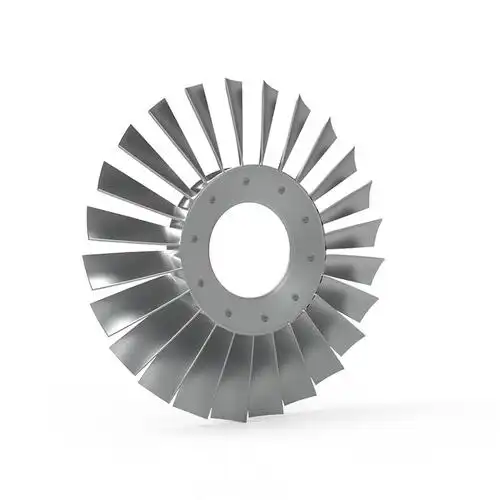
The selection of suitable cutting tools is of high significance in machining complex titanium impeller blades. Tapered ball-end mills and cylindrical cutters are the preferred tools because of their ability to accurately follow complex contours and reach narrow flow channels without any damage. Effective path planning must consider the blade curvature and stringent internal geometries, ensuring smooth transitions and avoiding tool collisions. Also, the order of operations must be optimized to minimize part deformation and maintain stability in roughing, semi-finishing, and finishing operations.
Process Parameter Optimization
Proper adjustment of cutting speed, feed rate, and depth of cut is required to achieve a balance between surface finish quality and tool life. This is especially crucial given titanium’s tendency to work-harden and generate heat. Parameter optimization typically involves extensive testing and simulation to identify the ideal conditions under which the wear on the tool is low and chattering or vibration is absent. Stable machining parameters are a significant factor in achieving precise dimensional accuracy and high-quality surface finishes.
Virtual Simulation And Verification
Complex CAM software like UG (Unigraphics) and MasterCAM also plays a crucial role in simulating tool paths before machining is attempted. The simulations reveal any potential collisions, undercuts, or areas where the tool can over-engage the material, enabling adjustments to be made in the virtual environment. This reduces costly trial-and-error runs, lessens the potential for ruining expensive titanium parts, and enables a smoother machining process.
Machine Precision And Rigidity
The intrinsic accuracy and stiffness of the multi-axis CNC machine are the foundation for producing high-precision titanium impellers. Geometric accuracy, high positioning repeatability, and rigid machine construction minimize vibration and deflections during machining. This stability directly affects the consistency of blade thickness, curvature, and overall dimensional conformity, allowing the impeller to meet stringent aerospace or industrial specifications.
Error Compensation
Incorporation of advanced error compensation algorithms into the machining process helps in the removal of deviations caused by tool wear, machine thermal expansion, and workpiece deflection. The systems provide automatic correction of tool paths and machining parameters in real time for achieving tight dimensional and form tolerances. Close error compensation is particularly important for titanium impellers where minute deviations impact aerodynamic performance and mechanical balance.
Practical Methods For Implementing Multi-Axis Machining In Titanium Alloy Impeller Processing
Practical strategies combine established techniques with innovative toolpath and process designs to optimize machining outcomes.
“3+2” Fixed-Axis Roughing
A common approach to roughing titanium impellers is “3+2” machining, where three linear axes are tied together with two rotational axes fixed for rough passes. The method employs ball and tapered cutters to eliminate bulk material effectively while conforming to intricate blade curvature and narrow flow channels typical of impeller geometry. With optimized cutter engagement and tool orientation, “3+2” roughing reduces cycle times and prepares the part for more precise finishing operations.
Five-Axis Finishing Strategies
Finishing involves high-end five-axis techniques such as side-edge drive milling and interpolation techniques. Side-edge drive refers to cutting along blade edges to finish sharp contours, while interpolation enables smooth sweeping of concave and convex surfaces, hubs, and blade roots. These techniques improve the surface quality through even tool contact and minimized tool marks. The capability to accurately contour complex shapes in a single setup improves dimensional accuracy and minimizes rework.
Toolpath Optimization
Toolpath planning also plays a key role in finding a balance between efficiency, tool life, and quality of surface finish. Techniques like helical milling and layered cutting reduce cutting forces by maintaining constant tool engagement, thus minimizing tool wear and heat generation. Further, vector optimization of the tool axis through adaptive tool orientation maintains the cutter at the ideal angle relative to the workpiece, reducing interference and achieving maximum surface smoothness. Optimization in this way boosts machining speed without any sacrifice in accuracy.
Process Workflow Management
A well-ordered process workflow improves process control and quality of finished parts. The overall order is:
- Rough Machining: Bulk material removal with “3+2” fixed-axis passes.
- Semi-finishing: Refining the features and preparing the surfaces for final finishing.
- Finishing: Five-axis high-precision milling with close tolerances and high-quality surface finish.
- Deburring And Corner Cleaning: Manual or automated deburring and removal of sharp corners to avoid stress concentrations.
- Final Inspection: Dimensional inspection using CMM or optical scanning to verify conformity to specifications.
Through the integration of these practical methods, manufacturers are able to use multi-axis machining to overcome the challenges of titanium alloy impeller production, achieving high accuracy, improved surface quality, and high productivity.
Challenges And Solutions In Multi-Axis Machining Of Titanium Alloy Impellers
Despite its benefits, this technology faces hurdles mainly related to material and machine constraints.
Challenges:
- High Cutting Forces And Tool Wear: Hardness and strength of titanium generate excessive cutting forces, leading to high tool wear and heat owing to low thermal conductivity.
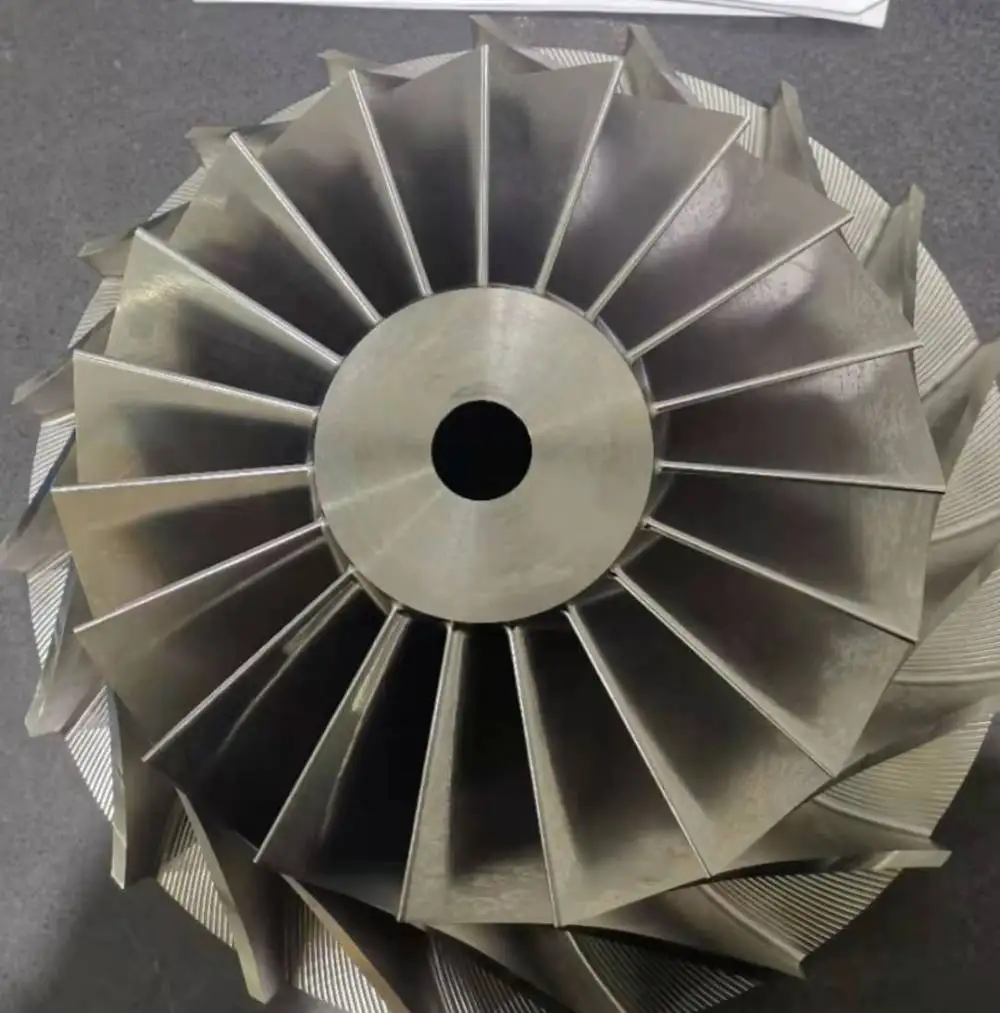
- Thin-Walled Blade Distortion: Fragile, thin blades tend to vibrate and distort during machining, resulting in dimensional inaccuracy and surface defects.
- Requirement for Machine Rigidity And Precision: Impeller geometries are sophisticated and require machines with high rigidity and precision in position to avoid vibration and misalignment.
- Tool-Workpiece Interference Hazards: Sharp curvatures of the blade and narrow flow channels increase the risk of overcut and tool impact, complicating tool path planning.
Solutions:
- Improved Tooling: Use of carbide or coated tools (e.g., TiAlN-coated) enhances wear resistance and heat tolerance, extending tool life.
- Improved Cutting Paths And Angles: Optimized tool orientation and path planning reduce tool engagement, eliminating interference and overcut hazards.
- Rigid, High-Accuracy Machines: High-rigidity, five-axis CNC machines repeatable stabilize the cutting conditions and reduce vibrations.
- Virtual Simulation: Pre-simulation using simulation software to predict collisions, overloads, and deformation allows advance adjustment of machining parameters.
- Adaptive Control Technologies: Dynamic adjusting of cutting parameters in real-time ensures optimum cutting conditions, protects tools, and enhances surface finish.
Collectively, these technologies surpass the key difficulties of titanium impeller machining with increased accuracy, efficiency, and reliability.
Future Trends In Multi-Axis Machining For Titanium Alloy Impeller Manufacturing
With the requirement for high-performance, weight-efficient components growing across aerospace, automotive, and energy sectors, multi-axis machining technologies evolve to meet increasingly stringent precision, efficiency, and sustainability requirements. The following upcoming trends will keep transforming titanium alloy impeller manufacturing:
Intelligent Machining
Artificial intelligence (AI), machine learning, and big data analytics are being integrated into CNC machines to enable real-time process optimization. These smart systems can analyze cutting conditions, tool wear, and machine behavior in real time—adjusting spindle speeds, feed rates, and tool paths automatically to deliver consistent quality and reduce downtime. Predictive maintenance with AI will also cut down on unplanned tool failure, delivering continuous production and higher yield rates.
Sustainable Manufacturing
Environmental considerations are now taking over manufacturing techniques. Multi-axis machining is moving towards cleaner techniques, like energy-efficient machine tools, dry or minimum quantity lubrication (MQL) cutting fluid systems, and improved chip recycling processes. These techniques allow manufacturers to conserve energy, waste, and coolant use according to global standards of sustainability without sacrificing high-precision outputs.
Standardization And Modularity
Future machine tool platforms will increasingly be standardized and modularized to enable more system interoperability and flexibility. This trend will make it easier to add new tool heads, sensors, and automation systems to enable faster reconfiguring for different impeller types and production rates. Modular systems also provide the capability for scalability, enabling manufacturers to scale up or down more easily with demand or product complexity changes.
Digital Twin Technology
Digital twin technology is attracting attention, allowing machine manufacturers to design exact virtual duplicates of machining environments as well as impeller parts. Digital duplicates make it possible to simulate accurately, predict errors, and adjust parameters prior to actual machining, cutting trial-and-error cycles by a large margin and first-pass yield significantly.
With the implementation of these forward-looking trends—smart control, green practices, modular machine building, and virtual simulation—production of titanium alloy impellers will be smarter, greener, and highly attuned to new technologies and market requirements.
Conclusion
Multi-axis machining technology is a cutting-edge approach to machining titanium alloy impellers, surpassing the material and shape challenges to deliver high accuracy and efficiency. With accurate tool choice, parameter adjustment, and virtual simulation, suppliers manufacture outstanding quality products. Future advancements in AI adaptive control and sustainable processes will still further exploit the capabilities and possibilities of multi-axis machining in this demanding industry.


