
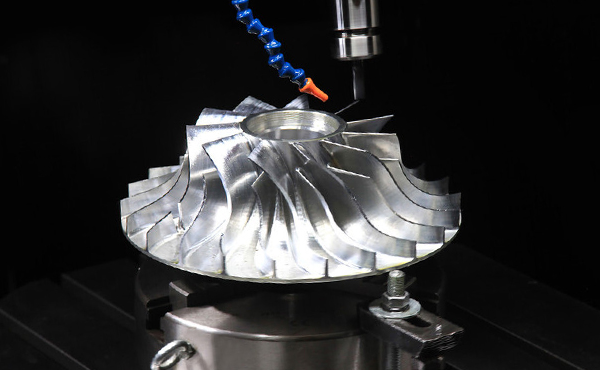
In high-performance industries such as aerospace, energy, and automotive manufacturing, vortex impellers play a pivotal role in achieving optimal flow dynamics and mechanical efficiency. However, their intricate design and tight tolerances present significant machining challenges. Conventional machining methods struggle to address the complexity of these components, leading to inefficiencies and potential inaccuracies. Fortunately, the advancement of five-axis CNC machining and Swiss-type lathes offers groundbreaking solutions for manufacturing vortex impellers with high precision and reliability. These technologies enable superior handling of complex geometries, enhance surface quality, and significantly reduce production time, marking a new era in precision engineering.
The Importance and Challenges of Impeller Machining
Impeller machining represents a critical juncture in the production of high-performance turbomachinery. These components directly influence flow dynamics, pressure ratios, and overall system efficiency. As such, any deviation in shape, dimension, or surface finish can result in significant aerodynamic losses or mechanical failures. However, achieving the required accuracy and repeatability poses considerable engineering and manufacturing challenges due to both geometric and material complexities.
Precision and Structural Complexity
Impellers are often characterized by intricate 3D geometries, such as twisted blades, undercuts, and deep narrow flow channels. These features are essential for guiding fluid flow effectively under high-pressure conditions. However, their complexity demands ultra-precise toolpath control and surface conformity during machining. Even a minor deviation—such as inconsistent blade thickness or slight tool deflection—can disrupt flow uniformity, reduce compression efficiency, and increase energy losses across the stage.
Material Hardness and Machining Difficulties
To meet operational demands such as high-temperature resistance, corrosion protection, and fatigue durability, impellers are often manufactured from materials like SUS316 stainless steel, Inconel, or titanium alloys. While these materials ensure strength, they are notoriously difficult to machine due to high hardness and low thermal conductivity. This leads to accelerated tool wear, increased cutting forces, and greater difficulty in maintaining surface quality over multiple parts. These issues are compounded when machining complex internal cavities or thin-walled blade structures.
The Demand for Consistency
In mass production scenarios, maintaining dimensional and structural consistency across batches is critical for performance standardization. Traditional 3-axis machining often requires multiple setups and tool changes to reach complex geometries. Each additional setup introduces alignment risks and cumulative errors, reducing repeatability and increasing quality control burdens. Five-axis machining technologies, although more advanced, must still be paired with robust process control systems to ensure uniformity in both prototype and production scales.
Five-Axis CNC and Swiss-Type Lathes in Impeller Machining
As impeller designs grow increasingly complex and performance standards rise, traditional machining technologies struggle to meet the demands of precision, efficiency, and scalability. To address these challenges, manufacturers are turning to advanced solutions such as five-axis CNC machines and Swiss-type lathes. These technologies not only enhance geometric accuracy but also enable high-throughput production of components with intricate profiles and tight tolerances.
The Rise of Five-Axis Machining
Five-axis CNC machining has revolutionized the way impellers are manufactured. Its ability to orient the cutting tool along five simultaneous axes allows for direct access to complex surfaces—such as twisted blades, deep channels, and varying contours—without the need for multiple setups or tool changes. This reduces the risk of misalignment, enhances part consistency, and enables the creation of highly optimized toolpaths that closely follow aerodynamic contours.
In addition, five-axis machines support high-speed machining strategies with dynamic tool engagement, improving material removal rates while minimizing vibration and heat buildup. This is especially beneficial when dealing with hard-to-machine materials like stainless steel or titanium alloys commonly used in aerospace-grade impellers.
The Swiss-Type Lathe Solution
Swiss-type lathes are ideal for manufacturing small, high-precision impeller components or shaft-related features in large volumes. Their distinguishing feature—a sliding headstock—provides exceptional rigidity by keeping the workpiece close to the cutting tool, reducing deflection and maintaining micron-level tolerances during intricate operations.
These machines are especially useful for producing miniature shafts, hub sections, and connector parts with deep holes or fine threads. With live tooling and multi-axis configurations, Swiss lathes can complete complex turning, drilling, and milling operations in a single cycle, drastically reducing processing time and human intervention. This makes them a preferred solution for medical, aerospace, and precision energy applications where consistent, high-volume output is essential.
Basic Principles of Five-Axis CNC Machining Technology
Five-axis CNC machining is transforming the production of geometrically complex components such as vortex impellers. Unlike traditional three-axis systems, which move the cutting tool along the X, Y, and Z axes, five-axis machines introduce two additional rotational axes (usually A and B or A and C). This enables the cutting tool to approach the workpiece from virtually any direction. As a result, surfaces with complex curvature, steep walls, and deep channels—common in impeller structures—can be machined with high precision in a single setup, significantly reducing alignment errors and processing time.
The simultaneous movement along all five axes allows for continuous tool engagement and optimal cutting angles, which reduces tool wear, minimizes surface deflection, and improves surface finish. This capability not only enhances part accuracy but also increases material utilization and supports the production of high-performance components made from hard-to-machine materials like titanium alloys or high-strength stainless steels. By integrating advanced CAM software and toolpath optimization algorithms, five-axis CNC technology provides a powerful foundation for modern precision manufacturing.
Advantages of Five-Axis Machining
In the field of advanced manufacturing, especially when dealing with components like impellers that feature complex curves and tight tolerances, five-axis machining offers unmatched performance. Its ability to perform simultaneous multi-directional cutting operations not only improves accuracy and efficiency but also significantly enhances production reliability. This makes it a critical technology in aerospace, energy, and high-end mechanical applications.
Superior Precision for Complex Geometries
Five-axis machining allows the cutting tool to approach the workpiece from optimal angles, enabling accurate machining of intricate 3D shapes such as twisted blades, deep cavities, and undercuts. This reduces the need for manual rework and ensures consistent dimensional accuracy across the entire surface, even in hard-to-reach regions.
Improved Efficiency and Reduced Setup Time
Because five-axis machines can access multiple sides of a component in a single setup, they greatly reduce the need for repositioning or secondary fixtures. This streamlines workflow, shortens cycle time, and minimizes alignment errors that typically occur in multi-step machining processes.
Extended Tool Life and Better Surface Finish
By maintaining optimal tool orientation during cutting, five-axis machining minimizes tool deflection and distributes cutting forces more evenly. This reduces tool wear, improves surface finish quality, and allows for longer tool usage—particularly valuable when working with difficult materials like titanium or nickel-based alloys.
Ideal for High-Value Components
For components like impellers, where surface quality, tight tolerances, and material integrity are paramount, five-axis machining offers the reliability and repeatability required. It supports both low-volume precision prototyping and high-volume production without sacrificing quality.
Greater Flexibility and Material Utilization
Five-axis technology is adaptable to a wide range of part sizes and shapes. It also enables optimized toolpaths that reduce material waste, making it not only a precise but also a cost-effective and sustainable solution for modern manufacturing challenges.
Application of five-axis machining to impeller machining
The manufacturing of impellers poses unique challenges due to their intricate geometries, such as twisted blades, deep flow passages, and varying thicknesses. Traditional machining methods often fall short in meeting the precision and efficiency demands of such components. Five-axis CNC machining provides a transformative solution, enabling accurate, efficient, and stable production of complex impeller structures. This technology is now essential in aerospace, energy, and turbomachinery industries where aerodynamic and structural performance are critical.
Precise Contouring of Complex Blade Geometries
Five-axis machines enable the tool to follow the contoured surfaces of impeller blades with continuous orientation adjustment. This allows for seamless machining of spiral and twisted surfaces that are common in modern high-performance impellers. The ability to align the tool perpendicularly to each surface significantly improves accuracy, reduces tool marks, and enhances aerodynamic integrity.
Efficient Machining of Deep and Narrow Channels
Impellers often feature narrow internal flow passages and deep curved regions that are difficult to access using traditional 3-axis setups. Five-axis machining overcomes this limitation by allowing multi-angle tool entry, ensuring thorough coverage without repositioning. This reduces the risk of tool interference, improves material removal rates, and ensures consistent wall thickness across complex internal structures.
Optimization of Machining Strategies and Tool Life
The flexibility of five-axis machining permits the use of specialized tools—such as tapered ball-end mills—and optimized tool paths that match the impeller’s geometry. This not only improves cutting efficiency but also reduces cutting forces, leading to better surface finish and longer tool life, especially when working with hard-to-machine materials like stainless steel or titanium alloys.
Reduced Setup Time and Increased Productivity
Five-axis systems reduce the number of setups required to complete an impeller, minimizing alignment errors and manual interventions. This streamlines the entire manufacturing process, enhances repeatability, and significantly boosts productivity—key benefits for both small-batch customization and mass production.
Integration with Digital Manufacturing and Simulation
Advanced five-axis machining centers can be integrated with CAM software and digital twin simulations. This enables virtual toolpath verification, collision checking, and parameter optimization before actual cutting. As a result, machining risks are minimized, and quality control is enhanced, ensuring that each impeller meets stringent industry standards.
Structural Characteristics of Machined Impellers
In high-speed rotating machinery, the structural integrity and precision of impellers are critical to performance, durability, and safety. Five-axis machining technology has become the standard for manufacturing impellers due to its ability to achieve exceptional geometric accuracy and surface quality. The resulting components exhibit features that directly contribute to reduced aerodynamic losses, improved balance, and longer service life, especially in demanding applications like aerospace, energy, and fluid machinery.
High Geometric Accuracy and Profile Consistency
Five-axis machining ensures uniform geometry across all blades and flow channels. Complex profiles—such as twisted blades and variable-pitch surfaces—are produced with minimal deviation, maintaining tight tolerances. This level of precision is vital for achieving symmetric airflow distribution and maximizing compressor or turbine efficiency.
Smooth Surface Finish and Low Roughness
The continuous multi-axis tool motion and optimized cutting paths result in smoother surface finishes compared to conventional machining methods. Surface roughness is significantly reduced, often reaching Ra < 0.4 µm. This enhances aerodynamic flow, reduces drag, and minimizes the risk of flow-induced vibration or fatigue cracks, especially in high-speed rotating environments.
Excellent Dynamic Balance and Symmetry
Consistent blade shape and thickness across the impeller ensure improved mass distribution and dynamic balance. This is crucial for minimizing rotational vibration and mechanical wear, especially at high RPMs. Balanced impellers reduce the load on bearings and extend the life of the entire rotating system.
Enhanced Structural Integrity in Critical Areas
Five-axis machining allows careful control of transitions between blade roots, fillets, and hub surfaces, reducing stress concentrations. This leads to better fatigue resistance and structural reliability under fluctuating thermal and mechanical loads, particularly in applications where impellers are subjected to high-pressure and high-temperature conditions.
Readiness for Coating or Post-Processing
The precision-machined surfaces are ideal for downstream treatments such as anti-corrosion coatings, thermal barrier applications, or surface hardening. Uniform geometry simplifies the coating process and ensures even layer distribution, which is essential for maintaining long-term performance in corrosive or erosive environments.
Machining Process Flow
The typical five-axis machining process for impellers follows a streamlined sequence of roughing, semi-finishing, and finishing, often completed in a single setup to maintain alignment precision. During the roughing stage, large volumes of excess material are rapidly removed to define the general shape of the impeller. Semi-finishing then refines the geometry, bringing it closer to the final dimensions while leaving a uniform allowance for finishing. This tiered approach reduces tool wear and improves machining stability, especially important when dealing with narrow blade gaps and curved channels.
Advanced Computer-Aided Manufacturing (CAM) software plays a pivotal role throughout the workflow. It generates optimized toolpaths tailored to the complex contours of the impeller, using strategies such as swarf cutting, drive surface machining, and spiral interpolation. Real-time collision detection and tool orientation control ensure that the cutting process remains interference-free, even in tight internal cavities. Furthermore, toolpath optimization helps minimize machining time and maximize surface quality, ensuring efficient material removal and prolonging tool life. This integrated approach enables high precision, consistency, and repeatability—critical for high-performance rotating components.
Key Application Case Studies
The versatility and precision of five-axis machining technology have made it a cornerstone in manufacturing complex components across various high-demand industries. Its ability to accurately produce intricate geometries with minimal setups and superior surface finishes enhances both product performance and manufacturing efficiency.
Aerospace Engine Blades
Five-axis machining is crucial for producing turbine blades that feature complex curved surfaces and internal cooling channels. These blades operate under extreme temperatures and stresses, requiring impeccable dimensional accuracy and surface integrity. The technology enables the fabrication of these critical parts with consistent quality, ensuring optimal aerodynamic performance and engine reliability.
Steam Turbine Blades
Steam turbine blades demand precise contouring and exceptionally smooth finishes to maximize energy conversion efficiency. Five-axis machining meets these requirements by allowing dynamic tool orientation and advanced toolpath strategies, which help achieve the tight tolerances and surface quality essential for reducing flow losses and improving turbine lifespan.
Wind Turbine Blades
While full-sized wind turbine blades are often too large for five-axis machining, smaller yet critical components within the assembly—such as blade roots and hub parts—are effectively manufactured using this technology. The precision machining of these parts ensures proper load distribution and efficient energy transfer, contributing to the overall performance and durability of wind turbines.
Other Industrial Uses
Beyond energy applications, five-axis machining finds extensive use in medical, automotive, and marine industries. It enables the production of complex rotary components like orthopedic implants, turbocharger rotors, and marine propellers. The technology’s capacity for intricate shapes and tight tolerances supports innovation and quality assurance across these diverse fields.
Operating Principles and Features of Swiss-Type Lathe Technology
Swiss-type lathes are specialized precision machines designed for manufacturing small, intricate parts that require exceptional accuracy and surface finish. Their unique sliding headstock mechanism moves the workpiece axially through a fixed guide bushing, unlike conventional lathes where the tool moves along a stationary workpiece. This design ensures continuous support close to the cutting zone, significantly reducing workpiece deflection and vibration, especially when machining long, slender components. The guide bushing surrounds the workpiece just behind the cutting tool, providing rigid support that minimizes bending and chatter, enabling extremely tight tolerances and fine surface finishes even on delicate parts.
Together, the sliding headstock and guide bushing system maintain exceptional concentricity and dimensional consistency throughout machining, making Swiss-type lathes ideal for producing small-diameter, high-precision components such as impeller shafts. Additionally, many Swiss-type lathes feature multiple tool stations and live tooling capabilities, allowing simultaneous turning, milling, drilling, and threading operations. This multi-tool capability enhances productivity and reduces cycle times for complex geometries, solidifying Swiss-type lathes as a preferred choice for precision machining of small, complex parts.
Core Advantages in Impeller Machining
Swiss-type lathes have become indispensable in the precision machining of small, complex parts like impellers, thanks to their unique capabilities and structural advantages. These machines offer exceptional rigidity and repeatability, which are critical for producing micro-components that demand tight tolerances and high surface quality. Their design enables stable machining of delicate parts without deflection or vibration, ensuring dimensional accuracy and consistency throughout production. This makes them particularly suitable for miniature impeller shafts and micro-turbine components where precision is paramount.
Moreover, Swiss-type lathes excel in low-volume, high-variety production environments, allowing manufacturers to quickly switch between different part designs with minimal downtime. Their multi-axis control and live tooling capabilities allow complex shapes to be machined in a single setup, reducing the need for multiple processes and improving efficiency. As a result, parts produced on Swiss machines exhibit superior straightness, concentricity, and surface integrity, all essential features for high-performance impeller components used in demanding applications.
High Precision and Rigidity
Swiss lathes provide unmatched stiffness and repeatability, ideal for machining micro-components with strict dimensional requirements.
Low-Volume, High-Variety Production
The machines facilitate rapid changeovers, supporting diverse impeller designs without sacrificing throughput or accuracy.
Complex Shape Machining
Equipped with multi-axis and live tooling, Swiss-type lathes can efficiently produce intricate geometries even on very small parts.
Impeller Applications
Increasingly adopted for small-diameter impellers and micro-turbine components requiring ultra-precise dimensional control.
Structural Features of Swiss-Machined Parts
The resulting parts demonstrate excellent straightness, concentricity, and surface finish, critical for reliable impeller performance.
Process Flow for Swiss-Type Impeller Machining
Swiss-type lathes are designed to deliver highly efficient and precise machining for small and complex parts like impellers. Their unique process flow ensures continuous operation from raw material feeding to finished component ejection, minimizing downtime and maximizing productivity. The close proximity of cutting tools to the guide bushing provides exceptional support to the workpiece, reducing deflection and enabling tight tolerance machining in a single setup. This seamless workflow is especially advantageous for high-precision impeller manufacturing, where consistency and accuracy are critical.
The process typically begins with bar stock feeding, where raw material is continuously supplied through the sliding headstock and supported by the guide bushing. Machining operations such as turning, milling, drilling, and threading are performed simultaneously using multiple tools arranged around the spindle. Thanks to the live tooling and multi-axis capabilities, complex features can be machined without the need for part repositioning or secondary setups. Finally, once all machining steps are complete, the finished part is automatically ejected, allowing for rapid cycle times and minimal manual intervention.
Process Flow for Swiss-Type Impeller Machining:
- Bar Stock Feeding:Continuous supply of raw material through the sliding headstock ensures uninterrupted machining and high throughput.
- Guide Bushing Support:Tools are positioned very close to the guide bushing, providing stable support that minimizes deflection and enables precision cutting.
- Simultaneous Multi-Tool Operations:Turning, milling, drilling, and threading can be performed concurrently with live tooling and multi-axis control, reducing cycle times.
- Single-Setup Complex Machining:Complex impeller features are machined without repositioning, avoiding cumulative errors and enhancing dimensional accuracy.
- Automatic Part Ejection:Completed parts are efficiently ejected to enable continuous production cycles with minimal operator intervention.
Comparative Analysis of CNC Five-Axis and Swiss-Type Lathes
In modern precision manufacturing, selecting the appropriate machining technology is crucial to meeting production goals, quality standards, and cost targets. Five-axis CNC machines and Swiss-type lathes each offer distinct advantages and limitations depending on the part geometry, size, and production volume. A comparative analysis of these two advanced machining methods highlights their structural differences, performance capabilities, and practical considerations, helping manufacturers choose the best fit for specific impeller machining applications.
Structural and Operational Differences
Five-axis CNC machines utilize rotating axes to orient the cutting tool relative to the workpiece, enabling complex 3D surface machining with minimal repositioning. In contrast, Swiss-type lathes feature a sliding headstock and a guide bushing system that provides exceptional stability and support for slender parts during machining, reducing deflection and improving accuracy.
Precision and Surface Quality
Both technologies achieve high precision; however, Swiss-type lathes excel in maintaining tight tolerances and superior surface finishes on small, intricate components. Five-axis CNCs are better suited for machining larger, contoured parts where multi-axis tool orientation is necessary to capture complex geometries.
Production Speed and Efficiency
Swiss-type lathes generally offer faster cycle times when producing small, simple parts due to their continuous bar feeding and close tool support. Five-axis CNC machines provide greater efficiency for complex or large-scale geometries by reducing setups and enabling simultaneous multi-axis movements.
Application Scope
The versatility of five-axis CNC machining covers a broad range of part sizes and shapes, including large impeller rotors with twisted blades. Swiss-type lathes specialize in machining long, slender components such as micro-impellers or miniature turbine parts that demand extreme dimensional control.
Cost and Economic Considerations
Swiss-type lathes often represent a more cost-effective solution for producing small-diameter parts, lowering labor and setup costs. Although five-axis CNC machines require higher initial investment, their adaptability and ability to handle diverse geometries provide strong long-term return on investment, especially for high-value or complex components.
Ease of Use and Maintenance
Swiss-type lathes typically need less frequent calibration but can involve complex tooling setups that require skilled operators. Five-axis CNC machines demand advanced programming expertise and more regular maintenance to ensure precision, reflecting their sophisticated mechanical and control systems.
Pros and Cons in Impeller Manufacturing
Choosing the right machining technology is essential in impeller manufacturing, as it directly affects product quality, production efficiency, and overall cost. Both five-axis CNC machines and Swiss-type lathes offer unique benefits and face certain limitations. Understanding the pros and cons of each method helps manufacturers optimize their processes and select the most suitable equipment for specific impeller designs and production requirements.
Five-Axis CNC Advantages
- Excels in machining intricate curved surfaces with high precision, making it ideal for complex impeller blades and flow channels.
- Enables multi-face machining in a single setup, significantly reducing repositioning errors and improving dimensional consistency.
- Particularly well-suited for large impellers and components with complex geometries that require simultaneous multi-axis tool movement.
Five-Axis CNC Disadvantages
- Generally involves higher initial investment and operational costs due to sophisticated machinery and tooling requirements.
- Requires skilled programmers and operators, with a steeper learning curve and longer setup times for complex parts.
Swiss-Type Lathe Advantages
- Highly efficient for low-volume, high-mix production environments, allowing quick changeovers between part types.
- Superior at producing small precision parts with tight tolerances, such as micro-impellers or miniature turbine components.
- Efficiently handles complex shapes and multi-axis machining on small, slender parts due to its sliding headstock and guide bushing design.
Swiss-Type Lathe Disadvantages
- Limited to smaller-sized components, making it unsuitable for larger impellers or parts with extensive contouring.
- Does not support simultaneous multi-surface machining, which can increase processing time for complex geometries.
- Challenges arise when machining large, complex contours that require the flexibility of five-axis tool orientation.
By carefully weighing these advantages and disadvantages, manufacturers can align their machining strategy with production goals, ensuring optimal performance, cost-efficiency, and product quality in impeller manufacturing.
Choosing the Right Technology for Impeller Machining
Choosing the Right Technology for Impeller Machining is a critical decision that impacts manufacturing efficiency, product quality, and overall cost-effectiveness. Different machining methods offer unique strengths tailored to specific production needs, impeller sizes, and complexity levels. By understanding when to use five-axis CNC machining versus Swiss-type lathe technology, manufacturers can optimize processes and meet precise performance requirements.
When to Choose Five-Axis CNC
- Ideal for large impellers featuring complex surface geometries that demand multi-directional tool access and precision shaping.
- Essential when single-setup operations are required to minimize alignment errors and reduce cycle times for intricate parts.
- Best suited for high-precision, high-efficiency production environments where dimensional accuracy and repeatability are paramount.
When to Choose Swiss-Type Lathe
- Perfect for small-volume, multi-variety batch production, allowing quick changeovers and flexible manufacturing.
- Recommended for producing small or micro-impellers that require extremely tight tolerances and fine details.
- Preferred when high rigidity, excellent concentricity, and surface integrity are critical for performance in miniature components.
By aligning the choice of machining technology with the specific requirements of the impeller design and production scale, manufacturers can enhance product quality, reduce lead times, and optimize operational costs.
Conclusion
Five-axis CNC machining and Swiss-type lathes each offer distinct advantages in impeller manufacturing. While five-axis excels at large, complex parts, Swiss machines shine in the production of small, intricate components. Understanding their strengths and limitations allows manufacturers to choose the right solution for their specific needs. As both technologies advance and converge, the future promises even greater precision, efficiency, and integration in the world of complex impeller machining.


